
Palm reading, also known as palmistry or chiromancy, is one of the oldest divination arts in the world, practiced across cultures for thousands of years. In Vedic tradition, it’s called Hasta Samudrika Shastra – the science of reading hands to understand personality, karmic patterns and life events.
If you’ve ever looked at your palm and wondered what those lines and bumps mean, this beginner-friendly guide will walk you through the major lines and mounts that form the foundation of palm reading.
About Shaastree’s Approach to Palmistry
Shaastree is an All-India Institute of Astrology & Vedic Science, trusted by over 1 lakh students globally for authentic courses in Vedic Astrology, Vastu, Numerology and Palmistry. Our teaching blends classical Vedic palmistry with practical, modern interpretations, making it accessible for absolute beginners and serious learners alike.
This guide is written for anyone curious about palmistry basics, whether you’re exploring it for personal insight or considering formal training in this ancient art.
What Is Palm Reading?
Palm reading is the practice of analyzing the shape, lines, mounts and markings on your hands to reveal insights about your character, strengths, relationships, career tendencies and major life events.
Unlike fortune-telling, traditional palmistry is about understanding patterns and potentials, not fixed predictions.
Which Hand Should You Read?
Most palmists recommend reading both hands for a complete picture:
- Dominant hand (the one you write with): Shows your current life, conscious choices and future direction.
- Non-dominant hand: Reveals your inherited traits, natural tendencies and past patterns.
Comparing both hands helps you see how you’ve shaped your destiny through choices and actions.
The Four Major Elements of Palm Reading
Before diving into lines and mounts, understand that a complete palm reading examines four key components:
- Hand shape (fire, earth, air, water types)
- Major lines (life, head, heart, fate)
- Mounts (fleshy pads under fingers and on palm)
- Minor lines and markings (crosses, islands, branches)
In this beginner’s guide, we’ll focus on major lines and mounts, which give you the most foundational insights.
The Major Lines: Heart, Head, Life & Fate
These are the “big three” (or four) lines that almost everyone has and that form the core of every palm reading.
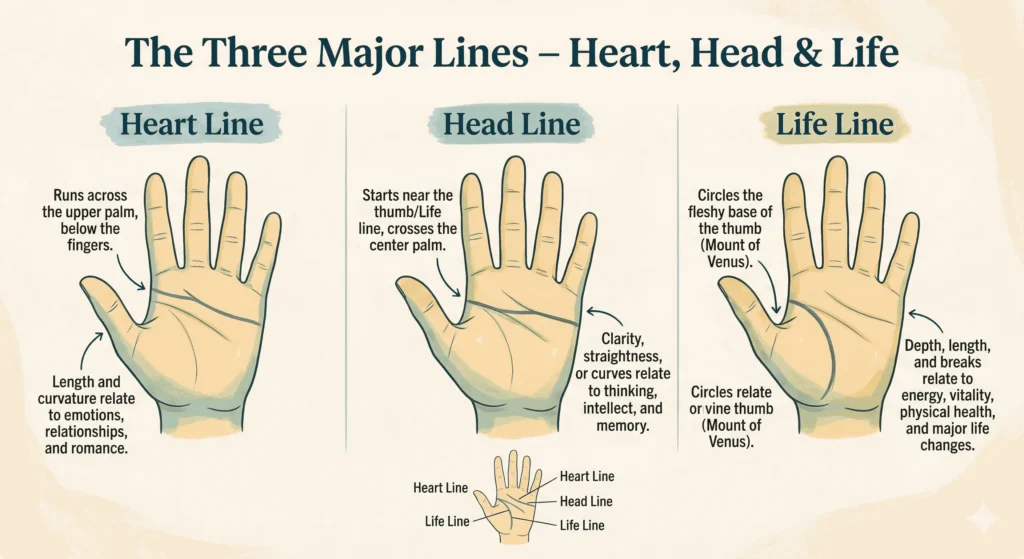
1. The Heart Line
Location: Runs horizontally across the top of the palm, just below the fingers.
What it reveals: Emotional nature, relationships, love life and emotional stability.
How to read it:
- Deep and clear: Strong emotional awareness, compassionate and affectionate nature.
- Curved upward toward fingers: Romantic, idealistic, emotionally expressive.
- Straight and level: More practical, reserved approach to emotions.
- Short heart line: Focused emotions, may be emotionally independent.
- Long heart line: Deep capacity for love and emotional connection.
- Breaks or islands: Emotional trauma, disappointments or transitions in relationships.
2. The Head Line
Location: Runs horizontally across the middle of the palm, below the heart line.
What it reveals: Intellect, thinking style, decision-making and mental focus.
How to read it:
- Long and straight: Logical, analytical, practical thinker; prefers evidence-based decisions.
- Curved or sloping: Creative, intuitive, imaginative; “right-brain” thinking style.
- Deep line: Clear, focused thinking with strong mental discipline.
- Short line: Prefers physical achievements over intellectual pursuits.
- Breaks or chains: Mental stress, inconsistent thinking or periods of confusion.
3. The Life Line
Location: Curves around the base of the thumb, starting between thumb and index finger, flowing toward the wrist.
What it reveals: Physical vitality, energy levels, health and major life changes – not the length of your life.
How to read it:
- Deep and long: Strong vitality, resilience, robust physical health.
- Wide arc (curving away from thumb): High energy, enthusiasm, love of life.
- Close to thumb (narrow arc): More cautious, reserved, lower physical stamina.
- Short life line: Does not mean short life; often indicates cautious or conservative nature.
- Breaks: Major life transitions, health challenges or significant changes in lifestyle.
- Chained life line: Fluctuating energy, ongoing challenges or ups and downs in health.
4. The Fate Line (Optional but Important)
Location: Runs vertically from the base of the palm toward the middle finger (Saturn mount).
What it reveals: Career, destiny, life purpose and external influences.
How to read it:
- Deep and clear fate line: Strong sense of purpose, clear career direction.
- Faint or absent: More flexible life path; success comes through self-direction rather than destiny.
- Breaks: Career changes, shifts in direction or life purpose.
Not everyone has a fate line, and that’s completely normal. It simply means you create your own path rather than following a predetermined destiny.
The Mounts: Planetary Energy in Your Palm
Mounts are the fleshy, slightly raised pads on your palm, located below each finger and on specific areas of the palm. In Vedic palmistry, each mount is associated with a planet and represents specific traits and energies.
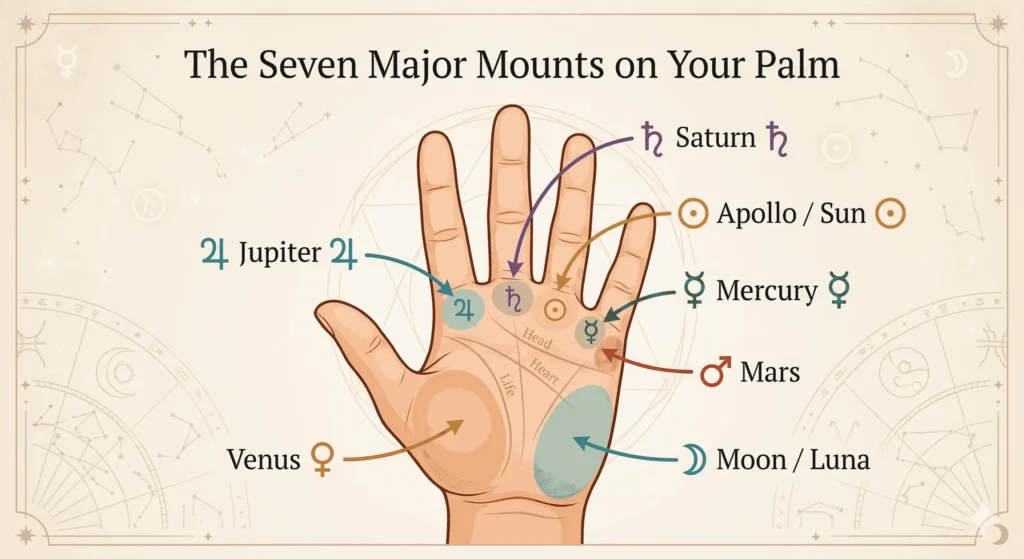
To see mounts clearly, gently curve your fingers inward and observe which areas appear most prominent.
The Seven Major Mounts
- Mount of Jupiter (below index finger)
- Traits: Leadership, ambition, confidence, wisdom, authority
- Well-developed: Ambitious, optimistic, good leadership skills
- Flat: Lack of confidence, low ambition
- Mount of Saturn (below middle finger)
- Traits: Discipline, responsibility, seriousness, karmic lessons
- Well-developed: Patient, responsible, introspective
- Overdeveloped: Pessimistic, isolated, overly serious
- Mount of Apollo / Sun (below ring finger)
- Traits: Creativity, arts, fame, happiness, self-expression
- Well-developed: Artistic, cheerful, charismatic
- Flat: Lack of creativity or self-confidence
- Mount of Mercury (below little finger)
- Traits: Communication, business sense, intelligence, eloquence
- Well-developed: Good communicator, business-minded, witty
- Flat: Shy, poor communication skills
- Mount of Venus (base of thumb, inside life line)
- Traits: Love, passion, sensuality, vitality, family affection
- Large/firm: Warm, passionate, affectionate
- Flat: Cold, low vitality, emotionally distant
- Mount of Moon / Luna (base of palm, opposite thumb)
- Traits: Imagination, intuition, creativity, dreams, emotional depth
- Well-developed: Highly imaginative, compassionate, artistic
- Flat: Unimaginative, practical, emotionally unexpressive
- Mount of Mars (two locations)
- Upper Mars (between heart line and head line): Moral courage, mental strength
- Lower Mars (near thumb, start of life line): Physical courage, aggression
- Well-developed: Courageous, assertive, resilient
- Flat: Timid, lacking in courage
How to Read Palm Lines Like a Pro: Quality Matters
When examining any line on your palm, traditional palmistry teaches that quality matters more than quantity:
- Deep, clear, unbroken lines: Strong energy in that area; favorable outcomes.
- Faint or thin lines: Weaker energy; less focus in that life area.
- Chained or island-marked lines: Obstacles, confusion or challenges.
- Breaks in lines: Major transitions, changes or disruptions.
- Branches upward: Positive developments, growth.
- Branches downward: Challenges, losses or setbacks.
Common Palm Markings for Beginners
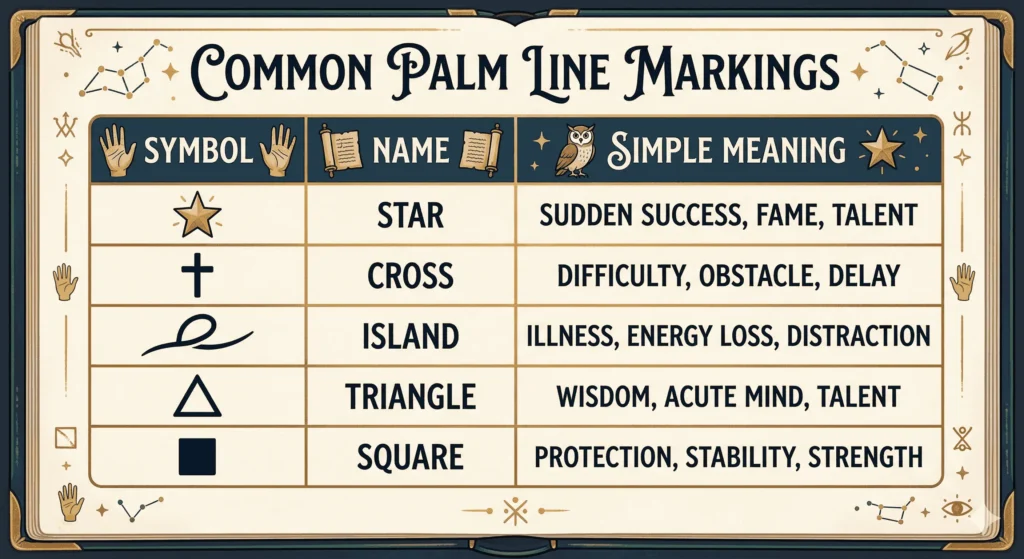
Beyond lines and mounts, small symbols and markings add layers of meaning:
- Stars: Sudden success or shock (depends on location)
- Crosses: Obstacles or significant events
- Islands: Periods of weakness, confusion or health issues
- Triangles: Talent, good fortune
- Squares: Protection, safety net during challenges
Practical Tips for Beginner Palm Readers
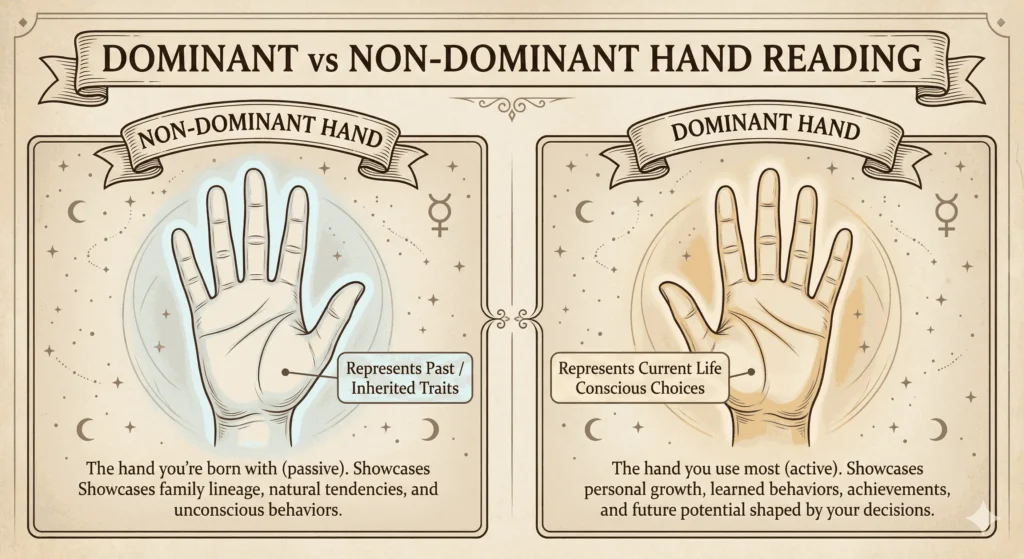
- Compare both hands: Notice differences between dominant and non-dominant to see how you’ve changed over time.
- Read in context: Don’t isolate one line; look at the whole palm for accurate insights.
- Practice on yourself first: Become familiar with your own lines before reading others.
- Use good lighting: Natural daylight is best for seeing fine lines and mounts clearly.
- Stay curious, not judgmental: Palmistry is about understanding, not labeling people as “good” or “bad.”
Taking Your Palmistry Further: Learn from Experts
If this introduction to palm reading has sparked your curiosity and you want to develop real skill in this ancient art, consider structured, expert-guided learning.
Shaastree offers a comprehensive Palmistry & Palm Reading Course designed for absolute beginners through advanced practitioners. The course covers:
- Hand shapes and types (fire, earth, air, water)
- All major and minor lines in depth
- Planetary mounts and their interpretations
- Predictive palmistry for timing life events
- Practical case studies with real hands
- Live interactive classes with experienced faculty
- Globally recognized certification upon completion
With over 1 lakh satisfied students globally, Shaastree has built a reputation for teaching authentic Vedic palmistry in a clear, accessible way, blending traditional wisdom with modern teaching methods.
Whether you’re exploring palmistry for personal growth or planning to practice professionally, expert guidance makes all the difference in developing confidence and accuracy.