
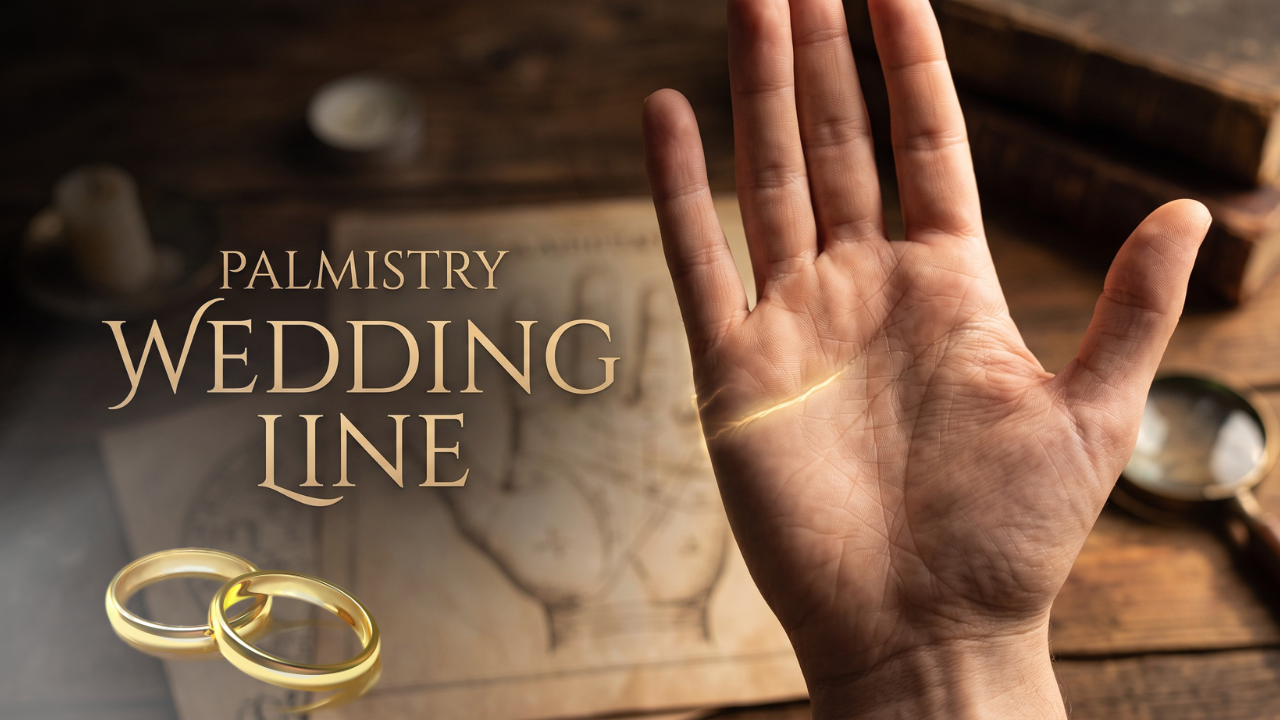
Almost everyone has curled their palm and looked just below the little finger at some point, wondering what those small lines mean. In palmistry, this area holds the marriage line, a short horizontal mark said to reveal patterns in your love life and relationships. Palmistry wedding line reading looks at the length, depth and shape of this line to understand emotional bonds and marriage timing. It is not a fixed prediction. Think of it as a traditional way of reading patterns, not a guarantee of what your future holds.
Where to Find Your Wedding Line
The marriage line on the palm sits at the edge of your hand, just below the little finger and above the heart line. It runs horizontally, cutting inward from the outer edge rather than across the whole palm. To see it clearly, curl your hand into a loose fist. This slightly stretches the skin near the pinky and makes the lines stand out much more than when your hand is flat and relaxed.
You can check either hand, but each tells a different story. Your dominant hand shows relationships shaped by your actual experiences. Your non-dominant hand reflects inherited or natural tendencies you were born with. In classical Indian palmistry, there is also an older convention: the right hand is read for men and the left hand for women. Many modern palmists still follow this alongside the dominant and non-dominant approach.
What the Number & Depth of Lines Reveal
The marriage line palmistry system pays close attention to how many lines appear and how deep they are, since both details change the reading.
- One clear line: Suggests one strong, defining relationship that plays a major role in your life. It does not mean this is your only relationship ever, but it stands out as the most significant one.
- Two or more lines: Usually point to multiple meaningful emotional bonds. This does not mean multiple marriages. It often reflects relationships that left a real emotional mark, whether they led to marriage or not.
- Deep line: Suggests a strong and lasting bond.
Faint or shallow line: Points to a connection that mattered but was less intense or shorter lived.
This line is also commonly called the love line in palmistry, since it reflects emotional attachment more than a legal marriage certificate.
Love Marriage or Arranged? Reading the Guru & Surya Parvat
A palm reading marriage line rarely gives a full answer on its own. To understand whether someone is more likely to have a love marriage or an arranged one, palmists also look at two mounts on the hand. The Jupiter Mount, called Guru Parvat, sits just below the index finger. The Sun Mount, called Surya Parvat, sits below the ring finger. Together with the marriage line, these two areas are traditionally read to judge the nature of a person’s marriage.
If the marriage line curves downward and the Surya Parvat is well developed, this combination is traditionally read as leaning toward love marriage, where personal choice plays the bigger role. If the marriage line is straight and flat, and the Guru Parvat is strong and raised, this points more toward an arranged or family supported marriage, where the family’s involvement matters more.
In classical texts, the love marriage line in the female hand is sometimes read separately from the male hand for this exact question, since older palmistry traditions treated the two differently. This part of palmistry wedding line reading is more layered than looking at one line alone. It works best as a general pattern, not a fixed rule for every hand.
Reading the Markings — Forks, Breaks, Chains & Curves
Small markings on the marriage line on hand add more detail to the reading, and each one is read differently. A fork at the end of the line is traditionally seen as a sign of divergence or separation. The relationship may not stay on one steady path till the end.
A break in the line points to a pause or disruption, not a permanent end. Many palmists read it as a phase the relationship goes through and moves past, rather than a final break. Chain-like or wavy relationship lines on the palm are read as emotional ups and downs. The bond exists, but it does not run smoothly, and effort is needed to keep it stable.
Curves matter too. An upward curve is generally read as a positive and stable outcome. A downward curve suggests more emotional strain or difficulty within the relationship. None of these markings should be read alone. They work alongside the line’s depth, length and position to build a fuller picture.
Marriage Timing — What the Position Tells You
- The position of the marriage line within this narrow strip gives a rough idea of relationship timing.
- A line sitting close to the heart line is traditionally read as an early bond or marriage, often in the younger years.
- A line in the middle of the strip points to a more conventional marriage age, the years most people associate with getting married.
- A line placed higher, closer to the base of the little finger, suggests a later marriage or a significant relationship that forms later in life.
These are approximate zones, not exact ages. The strip of skin is small, and even a slight difference in position can shift the reading by several years.
FAQs
Q1: Which palm line shows marriage?
Ans: The marriage line, found on the edge of the palm below the little finger and above the heart line, is read for relationship and marriage patterns.
Q2: Which line is for love marriage?
Ans: No single line confirms this. Palmists read the marriage line’s curve along with the Guru Parvat and Surya Parvat to judge love marriage tendencies.
Q3: What does 2 marriage lines in hand indicate?
Ans: Two lines usually mean two significant emotional bonds, not two marriages. It often reflects relationships that left a real emotional impact.
Q4: What does a broken marriage line mean in palmistry?
Ans: A break points to a pause or disruption in the relationship. It is traditionally read as a phase, not a permanent end.
Q5: What are the signs of divorce in palmistry?
Ans: A forked end or a sharp downward curve on the marriage line is traditionally linked to separation or a strained relationship outcome.
Q6: What if there is no marriage line on palm?
Ans: A faint or absent line does not mean no marriage. It may simply mean the bond does not leave a strong mark here.
Q7: Can the marriage line change over time?
Ans: Yes, palm lines can shift slightly with age and life experience. A reading today may look different after several years.
Q8: What is the 7-7-7 rule for marriage?
Ans: It suggests a date night every 7 days, a getaway every 7 weeks, and a vacation every 7 months to stay connected.